
Overview #
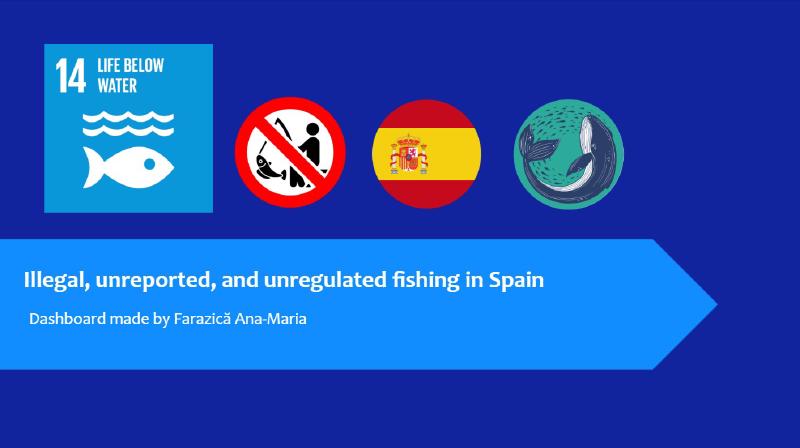
A data-driven dashboard investigating how illegal, unreported, and unregulated (IUU) fishing affects marine biodiversity in Spain and its surrounding Mediterranean waters — and what progress Spain has made in fighting back. Built following the CRISP-DM methodology as part of a first-year research project at Breda University of Applied Sciences.
The Challenge #
IUU fishing is one of the biggest threats to marine ecosystems in the Mediterranean. Despite international regulations, enforcement remains inconsistent, and the real impact on biodiversity is difficult to measure. The goal was to bridge that gap — turning scattered data from multiple sources into a clear, interactive story about what’s happening beneath the surface.
Research question: How does illegal fishing and overfishing affect the biodiversity of marine life in Spain and its surrounding waters, and what progress has Spain made in implementing IUU regulations?
Approach #
The project followed the full CRISP-DM pipeline — from business understanding through deployment:
Data Collection — Data was gathered manually from multiple authoritative sources: FAO fishery statistics for capture and aquaculture production (2018–2022), the IUU Fishing Index for Spain’s regulatory scores (2019, 2021, 2023), and the IUCN Red List for species conservation status and population trends.
Data Preparation — Each dataset was cleaned, filtered for Spain, and structured into custom spreadsheets. Columns were unpivoted for time-series analysis, data types were corrected, and blank rows were removed to ensure accuracy in Power BI.
Modeling & Visualization — The dashboard spans multiple interactive pages: species data with filterable tables, aquaculture vs. global capture comparisons, radar charts tracking IUU index scores over time, and scatter plots revealing correlations between marine protected area coverage and IUU detection rates. DAX measures were written for correlation coefficients and mean score calculations.
Key Findings #
Strong correlation discovered — A correlation coefficient of 0.89 between Marine Protected Area (MPA) coverage and reported IUU incidents revealed that increased protection leads to better detection, not necessarily more illegal activity.
Capture vs. aquaculture imbalance — Global capture values significantly outweigh aquaculture production in Spain, suggesting limited investment in controlled fish farming environments.
Regulatory progress is uneven — While Spain’s coastal and general IUU scores showed improvement between 2019 and 2023, port scores declined — highlighting a gap in monitoring at entry points for illegally caught fish.
Biodiversity under pressure — Analysis of IUCN Red List data showed that over 50% of assessed marine species in Spanish waters fall under “Least Concern,” but nearly 20% are classified as near threatened or higher, with many showing decreasing population trends.
Reflections #
Working with real-world environmental data taught me that the biggest challenge isn’t building the dashboard — it’s finding and reconciling the data. Many datasets were incomplete, published on different cycles, or structured in ways that made direct comparison difficult.
If I were to revisit this project, I would incorporate machine learning models for predictive analysis instead of relying solely on Power BI’s built-in forecasting. Adding socioeconomic data and stakeholder perspectives would also provide a more complete picture of why IUU fishing persists despite regulation.
Tech Stack #
Research Sources #
- FAO – Aquatic Species Search
- FAO – Aquaculture Production Statistics
- FAO – Global Capture Production Statistics
- IUU Fishing Index – Spain Profile
- IUU Fishing Index – Data Files
- IUCN Red List – Species Statistics
- OSPAR – Marine Protected Areas Assessment
- Global Initiative – IUU Fishing Risk Index Report (2023)
- Spain – A Progress Report on a Decade of Combating IUU Fishing (2020/2021)